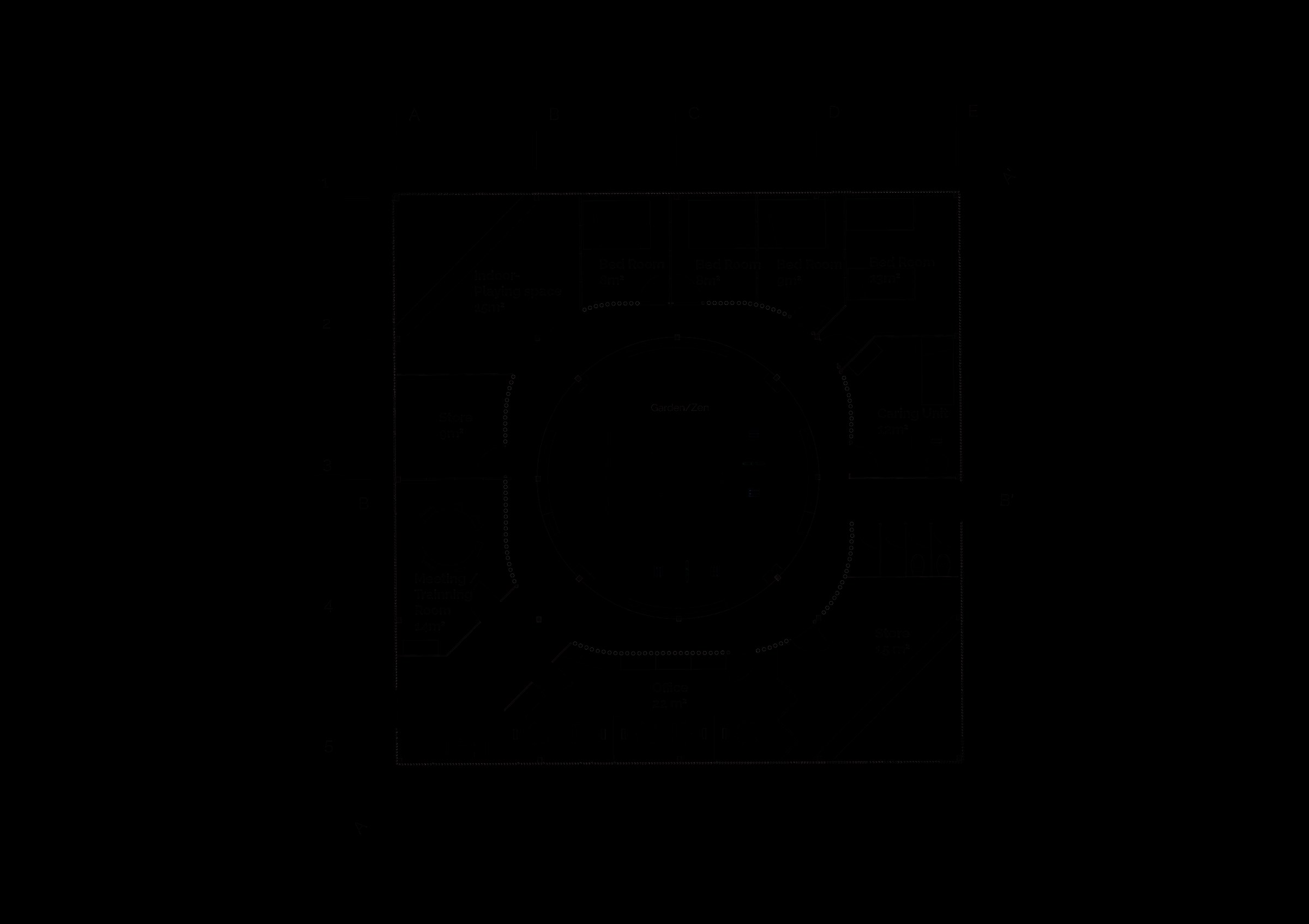
Program
The Kaira Looro 2022 competition called for a Children’s House in Baghere, Senegal — a facility to combat child malnutrition through an integrated set of programs: provision of nutritional materials, hygiene and healthcare awareness, pediatric and social care appointments, accommodation for at-risk patients, and the training of community nurses who will carry health knowledge into local families.
The design concept began from a quote: “A good physician treats the disease; the great physician treats the patient who has the disease.” This principle shaped everything that followed. The building would not look like a clinic. It would not remind a child that they are ill.
Spatial Concept: The Circle
The Senegalese way of life is organized close to Earth and Nature. In most West African settlements, the circle defines function — it is the spatial form of gathering, activity, and collective life. The proposal places this circle at the center of the plan: a circular Zen garden, open to the sky, at the heart of the building.
This central garden is enclosed by the program — care spaces, accommodation, nurse training rooms — arranged around its perimeter. The circle is inscribed within a 16×16m square outer geometry, a formal discipline that makes the plan rigorous from above while the interior remains experientially complex and spatially varied.
Form: Healing Pyramid
The outer geometry is a pyramid — the exaggeration of the inclined thatch roof forms of indigenous African vernacular architecture, taken to a scale that is immediately readable to a child and visible from a distance. The inclination of the walls creates the pyramidal silhouette from the exterior while generating the inclined surfaces that enclose and shelter the interior spaces.
The pyramid form was chosen for its associations: stability, groundedness, protection. For children in recovery — many of whom have experienced profound instability — a building that signals permanence and rootedness is part of the therapeutic program.
The highly inclined and vividly coloured walls that surround the central garden engage children directly: research consistently shows that children at this developmental stage recognize and are stimulated by strong shapes and colour. The pyramid’s interior is designed to be experienced as a discovery rather than a diagnosis.
Construction: Local Materials, Local Knowledge
The structure avoids imported construction systems entirely. Materials and techniques are local — harvested, formed, and assembled by the community:
- Thatch roofing: locally grown and harvested thatch layered over a timber substructure. A seasonal product used in traditional house construction, it provides familiar thermal performance and connects the building to its cultural context. Maintenance is required — the design acknowledges this as a feature, not a deficiency: maintaining the building is an act of community ownership.
- Clay bricks: formed on-site by local villagers. The construction process becomes community participation — the act of building the children’s house is itself a community investment in its success.
- Bamboo screen: a colourful wild bamboo screen wraps sections of the exterior, marking transitions in space and providing decorative identity to the building’s perimeter.
- Shells and fabric: used to decorate wall surfaces inside and outside — materials gathered from the local environment, integrating the building into its ecological and cultural landscape.
The building does not arrive as a finished object from outside. It is made from the place it serves.