Urban Strategy
The Ex-Macello site — a former abattoir on Milan’s urban periphery — sits at a threshold between established residential fabric and commercial infrastructure. The first move of the proposal was analytical: mapping the existing pedestrian paths, green corridors, and circulation networks that terminate at the site boundary, and extending them inward. This integration at the urban scale — connecting the Ex-Macello to the city’s green network rather than treating it as a standalone development — was the foundational design decision.
The program is organized along a west-to-east gradient: fully public commercial buildings to the west, grading through semi-public cultural uses and retail, to residential social housing at the eastern edge adjacent to the existing market. Density and privacy increase with distance from the public edge.
Vehicle-Free Interior
The access strategy removes all car traffic from inside the site. Parking for all residential and social housing units is located at the site perimeter — pushing vehicle infrastructure to the edge so that the interior becomes entirely pedestrian. This resolves a typical tension in dense mixed-use housing developments between the needs of car access and the quality of shared outdoor space.
The consequence is a sequence of outdoor rooms — connected by paths that grow from the extended urban network — that function as genuine public space rather than leftover traffic infrastructure.
Concept: Porosity and Synergy
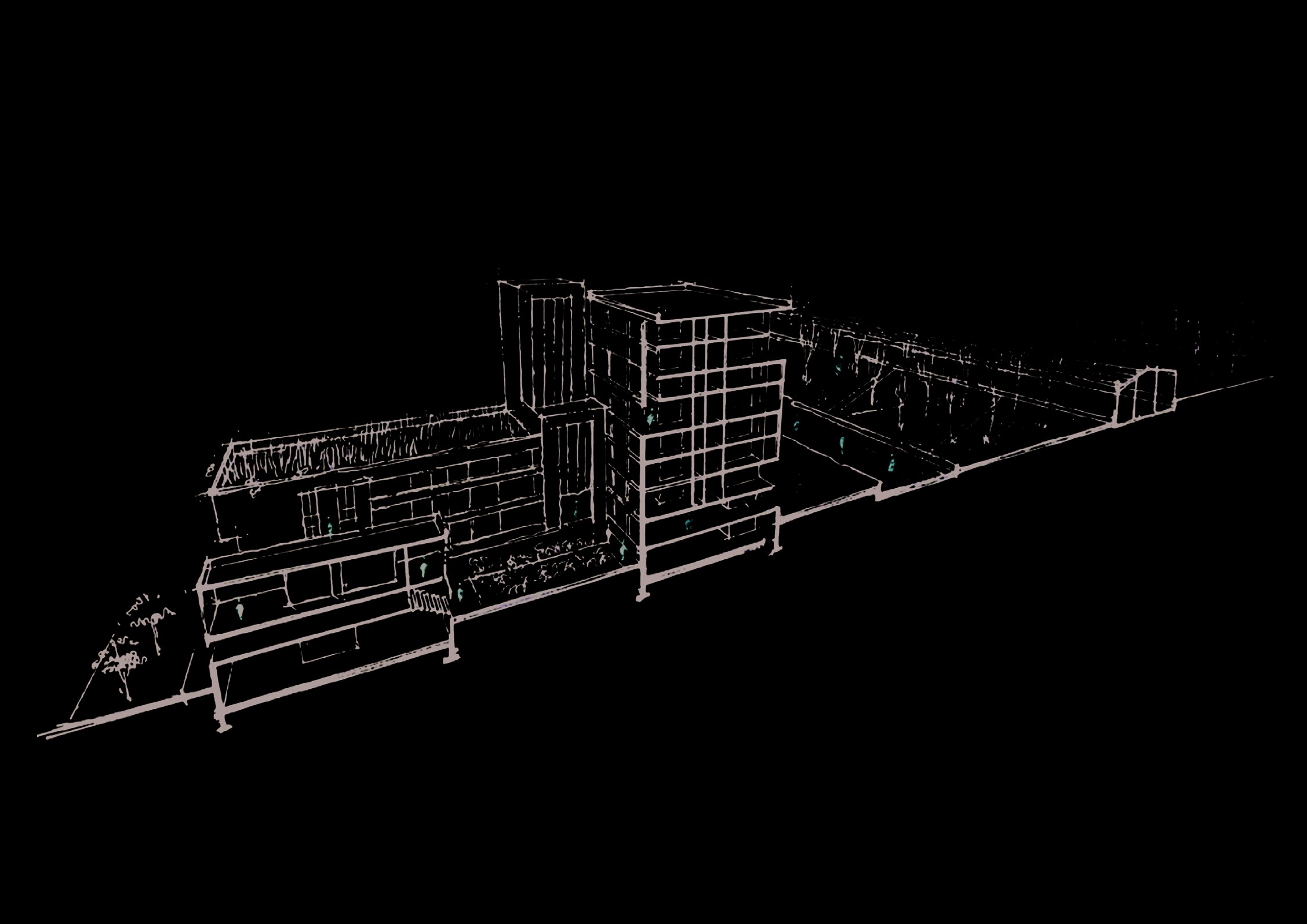
The building form follows the master plan geometry through two operations. First, porosity: ground-level passages were cut through the building volume at key points to maintain pedestrian permeability at human scale. This prevents the building from closing off internal space from the street network. Second, interlocking: volumes were offset and overlapped to create mutual outlook between blocks and maximize views into the interior landscape from the residential units.
The ground floor throughout the development is programmed as threshold space — co-working, reading rooms, cultural shops, cafés — belonging to neither the building nor the street exclusively, but activating both.
Facade and Passive Performance
The residential facades incorporate solar protection elements made of stainless steel mesh. The mesh serves multiple simultaneous functions: it reduces direct solar gain and thermal load on the facade, maintains natural air circulation (reducing air-conditioning requirements), provides visual privacy at close range while preserving views from within, and gives the building a distinct material identity — a fine-grained textured surface that reads differently at walking distance than from across the site.
An indirect greening system — vegetation supported by cables or mesh — is integrated into sections of the facade in a second scenario: evergreen planting that protects the facade from wind, snow, and rain in winter while providing additional shading in summer.
Roof Strategy
The roof is treated as productive surface rather than residual space:
- Photovoltaic panels across the primary roof area for on-site energy generation
- Drainage surface collecting rainwater for reuse in irrigation systems
- Green roof sections reducing heat gain in summer by up to 87% and heat loss in winter by up to 37%, and providing a surface for food production on-site
The combination of the mesh facade, green roof, and PV array constitutes a passive-first environmental strategy that reduces the mechanical systems load across the development.