Concept: Off Conventions, Off Consumption
A 5,000 m² office building positioned at a major crossroads on Via Federico Confalonieri in Milan — a site at the verge of a large-scale urban redevelopment. At a crossroads, architects conventionally choose between two typological responses: the tower, which marks the junction with height, or the plaza, which addresses it with ground-level public space. The proposal refuses the choice and merges both.
The tower condition is handled by a protruding cantilever that extends over the crossroads, creating a visual presence that reads from a distance. The plaza condition is embedded inside: a full-height atrium at the center of the building functions as an internal gathering space — bringing natural light and ventilation deep into the plan, and providing the social infrastructure of a public square within a private building.
Environmental Facade
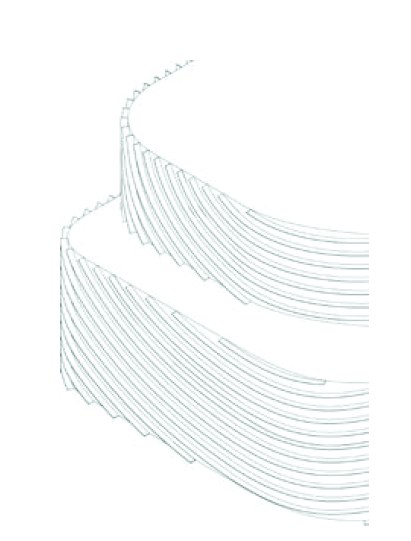
The primary design challenge was a curvilinear facade envelope designed to respond to solar geometry rather than to orthogonal building convention. Continuous exterior shading elements wrap the building’s perimeter, and their inclination angle is not constant: it transitions from vertical at the east and west facades — where low morning and evening sun requires vertical deflection — to horizontal at the south facade, where high midday sun requires overhead shielding.
The transition is continuous and computationally optimized: the inclination of each shading element is tuned to the angle of incidence of direct sunlight at that specific position on the facade, at the critical hours of the year. The result is a building whose envelope documents its own solar logic — every panel angle is a record of environmental data.
Ground Floor: Belonging to the City
The ground floor operates as civic infrastructure. Co-working space, a café, and a spacious lobby are organized around the base of the atrium, accessible to the public independently of the office program above. The building has separate entrances and elevator cores that allow the workspace to function quietly even when the roof garden or ground floor café is hosting events.
The upper floors divide along a plan logic driven by the site geometry: the eastern side is organized as free-plan open office, while the western side is subdivided into enclosed rooms. Each floor includes resting zones with views into the city and planting integrated into the section.
Technical Resolution: Facade Details
The facade was developed to full industry specification level — a detailed component assembly resolved at construction drawing depth.
Transparent system — Curtain Wall:
- Tempered fin glass (300×40mm) by Oldcastle BuildingEnvelope
- Aluminum stackwall channel framing with threaded rod anchorage
- ISOVER IBR K 4+ Fiberglass insulation (λ = 0.039 W/mK)
- Rigid thermal insulation Rock Mineral Wool 80mm (λ = 0.034 W/mK)
- CONSTRUCTION SPECIALITIES SF400 expansion joints at slab edges
- Anodised aluminium sheet cladding with structural silicone
- TATE LFFH raised access floor system (pedestal + panels + wooden finish tiles)
- Radiant heating system (Radiafloor) integrated into the raised floor
Opaque system — Aluminium Rainscreen Cladding:
- ALUCOBOND ACP panel with anodised aluminium finish
- EPDM waterproofing membrane 3mm
- Rigid thermal insulation Rock Mineral Wool 150mm
- XLPE polystyrene backup insulation
- EJOT self-drilling screws with polypropylene anchors
- Wall bracket system with thermal stop for thermal separation
- Terracotta roofing tiles 300×200×10mm at roof level
The curtain wall detail resolves the transition between transparent glazed sections and rainscreen panels — a junction that requires careful management of thermal bridging, differential movement, and continuity of the air barrier across dissimilar system types.